
Short answer: a manufacturer or B2B supplier in India needs a website because buyers now shortlist suppliers online before they make a single call, and a marketplace listing puts you on the same page as your competitors. A good B2B website is not a brochure. It shows what you make, the grades, sizes and capacity you can supply, the certificates you hold, the industries you serve and how to ask for a quote. This guide is written for factories, GIDC and MIDC units, fabricators, traders and industrial suppliers. It covers what buyers check, which pages to build, how the site works alongside IndiaMART and TradeIndia, and how to turn a visit into a request for quote (RFQ).
01Why does a manufacturer need its own website in 2026?
Because B2B buyers do most of their checking before they talk to you. In a 2025 Gartner survey of 632 B2B buyers, 61% said they prefer a buying experience without a sales rep. A later Gartner survey of 646 buyers found that 45% had used AI tools during a recent purchase. Buyers search, compare and ask AI assistants first, then contact two or three suppliers.
A purchase manager at an OEM in Pune or an exporter in Chennai typically checks four things before calling: does this supplier make exactly what I need, can they handle my volume, are they reliable and certified, and are they a real factory or a trader? If your website answers those questions, you are on the shortlist. If you have no website, or only a listing page, you depend on the buyer finding you in a crowd.

- Credibility: a site on your own domain with your plant photos and certificates shows you are an established manufacturer.
- Direct enquiries: buyers who find your site contact you only, not ten suppliers at once.
- Searchable products: every product page can rank on Google for the exact grade, size or part name a buyer types.
- AI answers: assistants such as ChatGPT and Gemini increasingly answer “who manufactures X in Gujarat?”. They name suppliers with clear, published facts. Our guide to AI search explains how.
- Export buyers: an overseas buyer will rarely send an order to a supplier with no website.
02Website vs IndiaMART: do you need both?
For most suppliers, yes. They do different jobs. A B2B marketplace such as IndiaMART or TradeIndia brings buyers who are searching inside the marketplace. Your website brings buyers who search Google or AI tools, and it is the place every buyer checks before trusting you, including buyers who first found you on a marketplace.
- Who sees you: a marketplace shows you next to competitors on the same page. Your website shows only you.
- Enquiry quality: marketplace enquiries are often sent to many suppliers at once, and many suppliers report mixed lead quality. Enquiries from your own site come to you alone and usually come from a buyer who has already read your specifications.
- Cost: marketplace plans are an annual fee that rises as you upgrade for more visibility. IndiaMART said in its Q4 FY26 results that it lost about 1,200 paying sellers after raising its Silver plan price. A website on a builder costs a small fixed amount a year.
- Ownership: your marketplace profile, reviews and rank stay with the marketplace if you stop paying. Your domain and your website stay with you.
- Brand: on a marketplace you are a listing. On your own site you control how your company, plant and team are presented.
The best setup: keep a marketplace listing if it brings you orders, and link it to your website. Put your website address on every quotation, invoice, visiting card and email signature, so every buyer ends up on the one place you control.
03What do B2B buyers look for on a supplier's website?
Purchase and quality teams look for proof, not slogans. These are the questions your site should answer within a minute:
- What exactly do you make: product names, grades, materials, sizes and tolerances
- Minimum order quantity (MOQ), monthly capacity and usual lead time
- Certificates: ISO 9001, ISO 14001, BIS, CE, IATF 16949 or others you actually hold
- Plant details: location, area, machines and in-house testing
- Industries and well-known customers you supply, with permission
- GST number, year of establishment and registered company name
- Packaging, dispatch and delivery: domestic and export
- A named contact person and a quick way to send drawings or an RFQ
Most supplier websites in India fail this test. They have a home page, an “About us” with a mission statement and a contact page. A buyer who cannot find the grade or the capacity moves to the next supplier.

04Which pages should a manufacturer's website have?
Start with these pages. Add more as you add product lines.
- Home: one line on what you make and for whom, your strongest proof (years, capacity, certificates, key customers) and two buttons: “View products” and “Request a quote”.
- Products or product categories: one page per product family, with a table of specifications, available sizes or grades, applications and photos of the real product.
- Infrastructure or plant: machines, capacity, testing lab and photos of the shop floor. This is the page buyers use to judge whether you are a real manufacturer.
- Quality and certificates: each certificate with its number and validity, your inspection process and the test reports you can provide.
- Industries served: automotive, pharma, construction, textile, agriculture and so on, each with a short note on what you supply to that industry.
- About: company history, directors or founders by name, GST number, registered address and plant address.
- Contact and RFQ: a short request for quote form, phone, WhatsApp, email, plant address with a map and office hours.
05How to write product pages that rank and convert
Product pages are where most B2B search traffic lands. A buyer searching “SS 304 seamless pipe manufacturer Ahmedabad” or “HDPE granules supplier Gujarat” wants a page about exactly that.
- Use the name buyers search for in the page title and first line, including the grade or standard: “SS 304 seamless pipes, ASTM A312”, not “Premium pipes”.
- Start with a short answer: what the product is, the sizes or grades you make, the MOQ and the lead time, in two or three sentences.
- Add a specification list as text: material, size range, thickness, tolerance, finish, standard and packaging. Avoid putting specifications only in an image or a PDF catalogue.
- List applications: which industries and machines the product is used in. Buyers search by application too.
- Show real photos of your product, your machines and finished batches. Stock photos make buyers suspicious.
- End with a quote button that opens the RFQ form with the product name filled in.
Keep a downloadable catalogue PDF as well, but never as the only place your specifications appear. Search engines and AI tools read a web page far more reliably than a PDF.

06Trust signals that win B2B orders
A new buyer is taking a risk on you. Every page should lower that risk.
- Numbers: years in business, monthly capacity in tonnes or pieces, number of machines, number of customers served, export countries.
- Certificates with numbers: a logo alone is easy to fake. Show the certificate number and the certifying body.
- Customer names and logos, only with permission. Even “supplying to 3 of India's top 10 two-wheeler makers” helps.
- Plant photos and a short video of the production line.
- Named people: the director, the sales head and the quality head with their roles. Buyers like to know who they will deal with.
- Registration details: GST number, CIN or Udyam registration, and the full registered address.
- Case examples: one paragraph on a problem you solved for a customer, such as a tighter tolerance or a faster delivery.

07Turn visits into RFQs: the request for quote form
The form is where a visit becomes an enquiry. Make it short enough to fill on a phone, but useful enough that you can quote without three follow-up calls.
- Name, company name and phone number (required)
- Email (optional, many buyers prefer WhatsApp)
- Product, with the product name pre-filled from the page
- Quantity and unit: pieces, kg, tonnes or metres
- Delivery location (city or pin code)
- A box for specifications or a note on the drawing
- Required by date (optional)
Next to the form, add a WhatsApp button and a phone number, so a buyer in a hurry can still reach you. Reply to every RFQ within one working day, even if only to say when the quote will come. Speed is often the first thing a buyer compares.
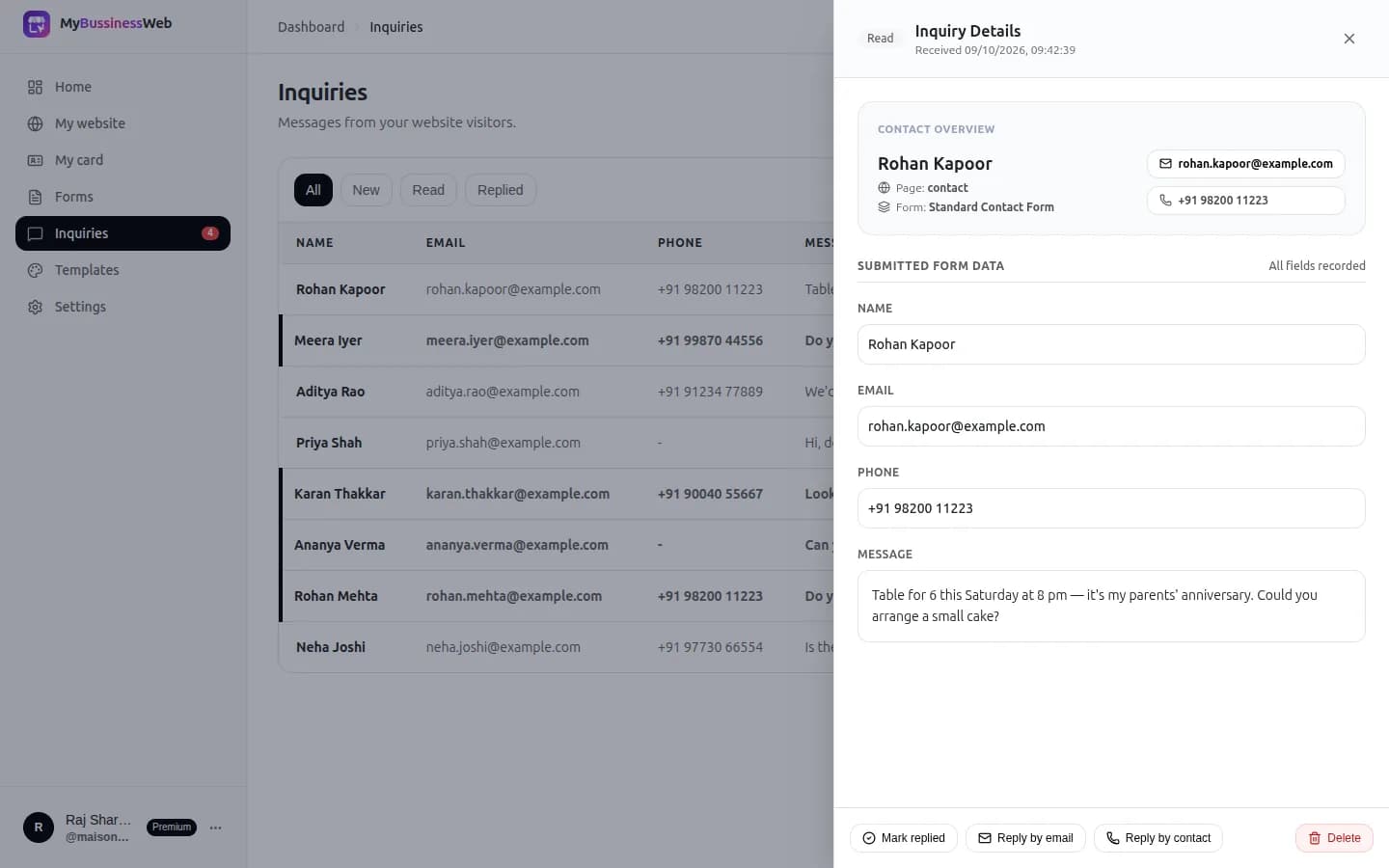
Our guide to enquiry forms people actually fill in has more on form length, buttons and follow-up.
08Local and industrial SEO for manufacturers
Buyers often search with a place: “CNC machining job work Rajkot”, “plastic moulding Vapi GIDC”, “steel fabricator near Chakan MIDC”. That makes local SEO useful even for B2B.
- Google Business Profile for your plant and office, with the right category (for example “Manufacturer”, “Steel fabricator”, “Plastic products supplier”), photos of the plant and your product list.
- Industrial area in your text: name your estate, such as GIDC Naroda, Sachin, Vapi, Waluj or Peenya, on your contact and product pages.
- Same facts everywhere: your company name, plant address and phone identical on Google, your website, IndiaMART, TradeIndia, Justdial and your association directory.
- Industry directories and associations: your local industries association, export promotion council or product association. These links tell Google and AI tools that you are a real, established supplier.
- Structured data: your website should describe your company as an organization with address, phone and products. OREYM adds business structured data to every published site.
09Getting named when buyers ask AI tools for suppliers
Purchase teams now ask assistants questions like “list manufacturers of food-grade HDPE containers in Gujarat with ISO certification”. The answer names suppliers whose websites state those facts clearly.
- State your product, location and certificates in plain sentences on your home and product pages.
- Add a short FAQ to each product page: MOQ, lead time, sizes, sample policy, payment terms, delivery areas.
- Keep facts current. An old capacity figure or an expired certificate can be repeated by an AI for months.
- Be listed where AI tools look: Google Business Profile, trade directories, association lists and news about your company.
The full method is in our guide to getting found in AI search.
10After the enquiry: follow up like a professional supplier
- Reply within one working day with a quote or a clear date for one.
- Send your quote with your website link, catalogue and certificates attached, so the buyer can share it inside their company.
- Offer a sample or a plant visit for a large or repeat order.
- Follow up twice: after three days and after ten days. Most B2B orders are won on the second or third contact.
- Save every enquiry with the product, quantity and source. After a few months you will see which products and pages bring orders.

11What does a manufacturer's website cost, and how long does it take?
A custom industrial website from an agency is often quoted from ₹50,000 to ₹2,00,000, with a yearly maintenance fee. A website builder costs far less, and you can update products and capacity yourself. Our website cost guide breaks down each route over three years.
On OREYM, plans cost ₹150 to ₹250 a month, or ₹1,200 to ₹1,500 a year, plus your domain. Templates for manufacturers, factories, industrial suppliers, plastic businesses and steel suppliers already have product, capacity, certificate and RFQ sections. Most suppliers can publish a first version in a day or two, once they have product details and plant photos ready.

12Manufacturer website launch checklist
- Domain in the company's name, such as yourcompany.in or .com
- Home page states what you make, for which industries, and your strongest proof
- One page per product family with specifications as text
- MOQ, capacity and lead time stated clearly
- Certificates with numbers and validity
- Plant and machine photos taken by you
- Industries served and customer names (with permission)
- GST, registration details, registered and plant address
- Short RFQ form plus phone and WhatsApp on every page
- Google Business Profile for the plant, linked to the website
- Same name, address and phone on IndiaMART, TradeIndia and directories
- Website link on quotations, invoices, visiting cards and email signatures
Common questions
Does a manufacturing company need a website if it is on IndiaMART?
Yes. A marketplace shows you next to competitors and keeps your profile if you stop paying. Your own website brings direct enquiries from Google and AI search, and it is where buyers from every channel check you before they order.
What should a manufacturer's website include?
Product pages with specifications, MOQ, capacity and lead time; a plant and infrastructure page; certificates with numbers; industries served; company and GST details; and a short request for quote form with phone and WhatsApp.
How can a B2B supplier get enquiries without IndiaMART?
Publish product pages that name the exact grade, size and location buyers search for, set up a Google Business Profile for the plant, list the company in trade directories and associations, and put the website link on every quote and invoice.
How much does a website for a manufacturer cost in India?
From about ₹1,200 to ₹1,500 a year on OREYM plus the domain, to ₹50,000 to ₹2,00,000 or more for a custom agency website. The right choice depends on how many products you have and how often you update them.
Should I put prices on a B2B website?
Usually not exact prices, because they depend on quantity, grade and delivery. Show MOQ, price basis (per kg, per piece) and lead time, and ask for an RFQ. Where you have standard items, a price range helps buyers qualify themselves.
Is a PDF catalogue enough for a manufacturing website?
No. Keep the PDF for download, but write the specifications on web pages too. Search engines and AI tools read web pages far more reliably than PDFs, and buyers on a phone rarely open large files.
Written by Sahil Patel
Product & growth, OREYM
Sahil works with shop owners, clinics and service businesses across India on getting found online and turning visitors into enquiries.


